
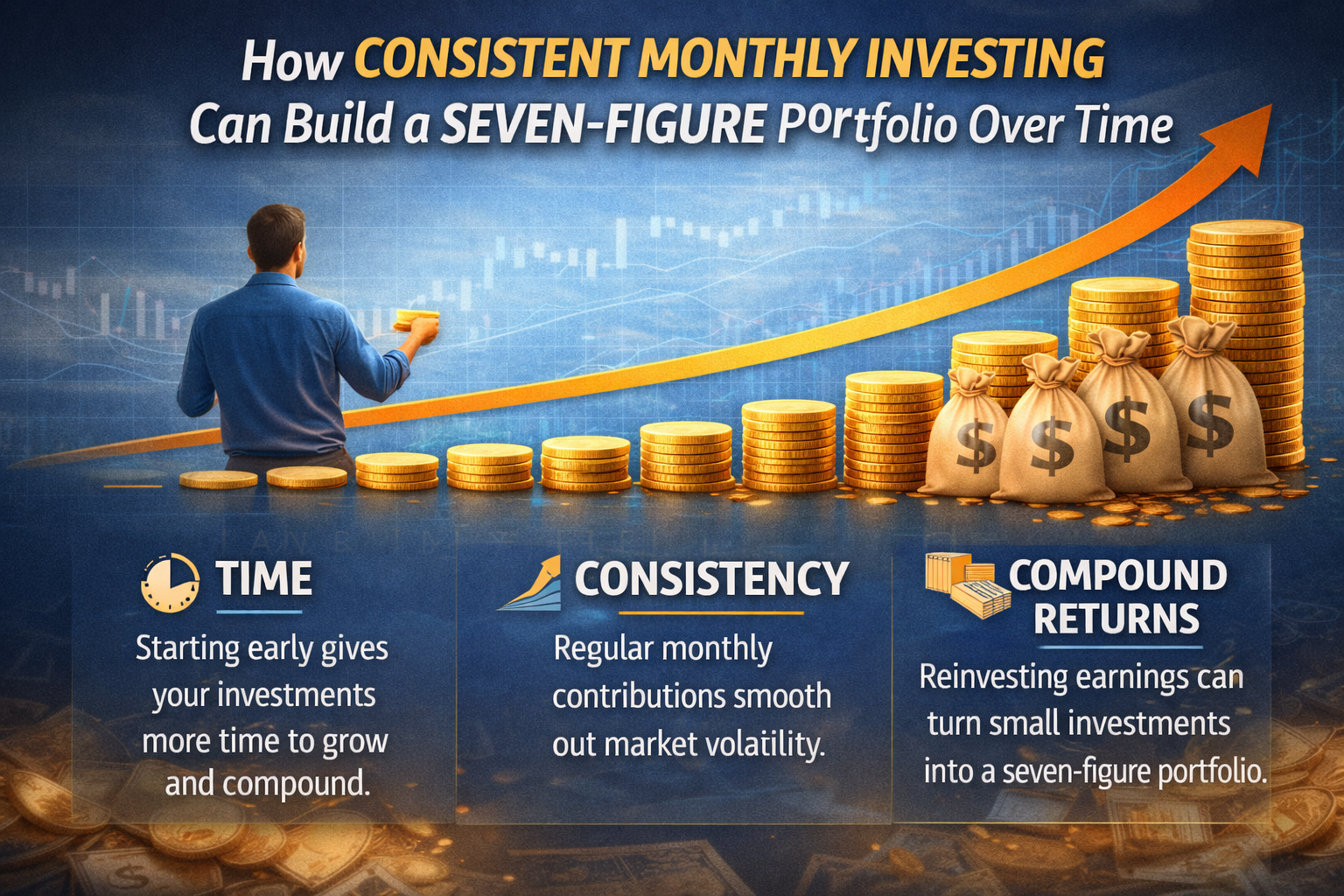
Achieving a millionaire status is not necessarily dependent upon having an enormous salary, receiving an inheritance, or engaging in high-risk trading methods. In fact, often, it requires only consistency, patience, and taking advantage of the time value of money.
One popular investment methodology that is widely discussed nowadays is the practice of investing a set amount of money every month. For example, £500 (£6,000 each year) into some type of investment vehicle over an extended period.
The basic premise behind this methodology is based on compound growth. When you invest, your investments will create a return on investment, which can then be reinvested back into additional investments, thereby generating a good return. In other words, create money from the money that you previously created. This process will, over time, lead to exponential growth in the dollar value of an individual’s portfolio, regardless of how large or small their monthly contribution amounts are.
For example, if you were to invest £500 every month, after just one year you would have invested £6,000. This amount by itself does not sound particularly impressive. However, if this amount is invested in assets that historically provides an average return of 7-10% per annum, as the majority of stock markets tend to do, after 30 to 35 years of regular monthly investments, this strategy could potentially yield a value greater than £1 million.
Besides good returns, this strategy also minimizes the risk associated with market timing; rather than attempting to speculate on exactly which day is going to be the best time to start investing, by making consistent, regular contributions into a variety of different markets. This allows for reducing exposure to significant price declines shortly after making a substantial investment.
This approach often known as “Pound cost averaging”, allows investors to average out the volatility in the price of the asset due to price fluctuations that occur over time, from day to day.
Choosing the right investment vehicle can be equally as vital as other factors, such as finding the correct allocation of stocks and bonds, when saving for retirement. The most common vehicles for individual investors are low-cost index mutual funds and low-cost exchange-traded funds (ETFs) that track a broad market index.
By diversifying across multiple sectors and companies, an investor is less at risk of being negatively impacted by a single company’s poor performance. Because of their low fee structure, an investor’s money will remain invested for a longer period and compound at a higher rate than if an index fund or ETF were purchased with the same amount of money in a short period.
Another big benefit of this type of strategy is time; the sooner you begin to save for retirement, the greater the potential for your investments to grow over the long term. For example, if a person starts saving at age 25 by contributing £500 every month, they will likely have a much larger account balance by age 65 than someone who only started contributing at age 45.
While both individuals would have invested the same amount throughout their lives, the first investor will have one extra factor: more years for compounding to occur. In addition to early investment, consistency is equally important as markets go up and down, and there will be times of poor performance.
Contributing to an investment when the markets are down can be advantageous as you are able to acquire assets at discounted prices. If you cease making contributions or decide to sell your investments during periods of stress in the financial markets, your overall returns will suffer greatly in the future.
Inflation is another important factor to consider. While cash might feel like a safe place to keep funds, the effects of inflation steadily reduce purchasing power. Investing allows for a greater growth potential from your invested dollars than keeping them as cash, therefore preserving and furthering the amount of real wealth you may hold over time.
Every investment involves risk, and therefore every investment strategy involves risk. Also, even though it is impossible to ever provide guarantees that your investments will produce returns, historical trends have shown that similar types of investments have produced both positive and negative returns at different time periods in history.
Therefore, investors must have patience and stick to their long-term investment strategy, as this provides them with the opportunity to receive a “good” return for continuing to believe in their investment strategy. Another important point regarding wealth is that it is typically not created through making larger financial investments; rather, most wealthy individuals become wealthy over time using slow and steady methods.
The same is true for the example of investing £500 each month; over time, if you keep your investment and allow it to compound, the average amount invested may become extraordinary savings after a certain number of years.