
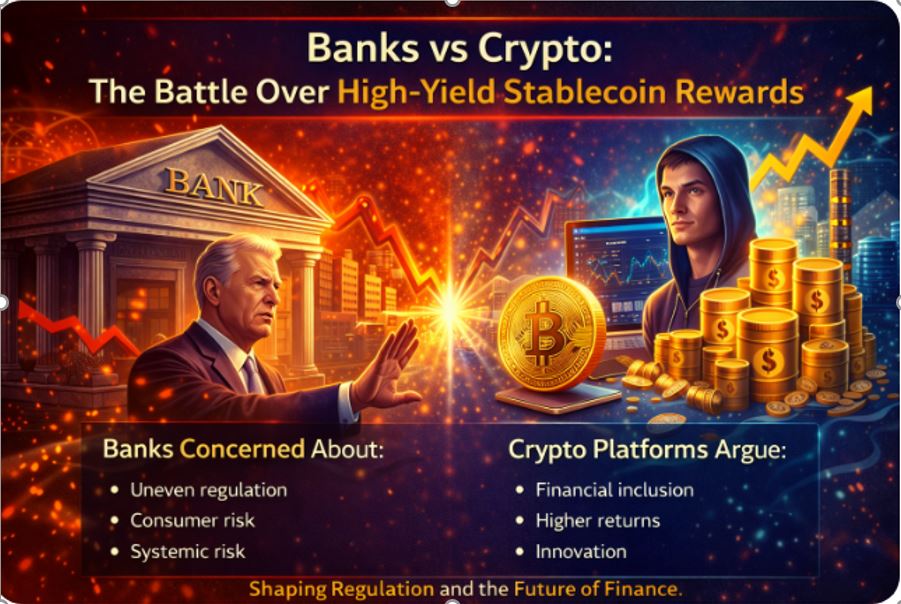
The global financial system is experiencing a transition into a new era of disruption as a result of ongoing conflict between banks and crypto platforms over high-yield stablecoins. The rewards offered by these stablecoins are far greater than those offered by traditional banks, raising concerns regarding the regulations, consumer protection, and overall stability associated with these types of investments. The continued struggle between these two sectors will continue to guide the establishment of digital asset regulations, particularly as governments worldwide are currently contemplating drafting new legislation governing digital assets.
This article discusses why there is increasing tension between banks and the cryptocurrency community, the workings of various high-yield stablecoins, and how they function, and why high-yield stablecoin offerings may lead to increased regulation of the industry in the near future.
How Do High-Yield Stablecoin Rewards Work?
The high-yield stablecoin is a type of cryptocurrency that is designed to have a stable value through a combination of British Pounds and US Dollars. Stablecoins are primarily used for trading, payment, and storing, rather than the extreme volatility of regular cryptocurrencies. Recently, many crypto platforms have launched new ways to reward people with high-yield stablecoin options.
Typically, these options are offered to earn yearly rates of ten to fifteen percent or higher through decentralized lending, market-making, and liquidity pools. Since these returns are significantly higher than what most traditional banks will pay as a savings account rate, stablecoin offerings are attracting millions of users worldwide.
Why Banks Are Worried?
According to traditional financial institutions (e.g., traditional banks), high-yield stablecoins create confusion between the services they offer (i.e., the traditional banking services that they provide) and other “traditional” (not regulated) products.
In their opinion, crypto platforms are essentially offering a product similar to a bank’s deposit account without having to operate within the same set of regulatory constraints. Therefore, the main concerns expressed by traditional banks regarding stablecoin products are as follows:
- There is an unequal regulatory environment in which crypto platforms have been able to develop and market their high-yield stablecoin products without fulfilling the same strict capital and compliance requirements as traditional banks.
- When stablecoins are marketed as savings or investment products and do not carry a guarantee of return (i.e., the yield earned is based on market conditions), consumers may have a less reliable investment option than with a traditional savings account; and
- If large amounts of money are moved from banks into stablecoin products, it creates systemic risk within the banking system.
For these reasons, representatives of traditional banks are increasing their lobbying activities in an attempt to create a regulatory framework for crypto platforms similar to that of traditional banks, especially when stablecoins are marketed as savings or investment products.
Crypto Platforms Pushback
The crypto platforms contend that stablecoin rewards are different from bank’s saving accounts. They further argue that consumers who use Crypto Platforms typically enter into these platforms at their own risk, and that consumers are aware of the fact that they are not guaranteed by any central bank or other regulatory body like a Bank Depositor.
The proponents claim that crypto platforms have improved financial inclusion across areas where banking is not available, brought innovation in financial services by offering competitive returns, and have offered increased transparency through blockchain technologies. Therefore, regulating Crypto Platforms under the traditional Banking Regulations would not only limit consumer access to Stablecoins but also slow down the innovation within global financial systems.
Read: Why AI-Powered Cryptocurrencies Are Gaining Attention Among Long-Term Investors?
Policy Debate and Regulatory Response
In response to this debate, various lawmakers globally have taken notice of this debate and are beginning to discuss the classification of Stablecoins. In the United States and Europe, there is an active discussion regarding whether Stablecoins should be classified as either Securities, Banking Products, or a new category of financial product.
Expected outcomes include one or more of the following: Licensing requirements for Stablecoin Issuers, restrictions on the ability of crypto platforms to advertise high-yield crypto products, requirements for crypto platforms to disclose their reserve balances and audit those balances, and limitations on the ability of crypto platforms to establish yield-bearing stablecoin accounts.
These discussions will have an extremely large impact on the establishment of the first Exchange Act and the development of the Digital Asset Regulatory Environment in the United States.
Consumer and Investor Impact
Users may see both positive and negative consequences from the regulatory conflict. Users are likely to benefit from an increase in the level of regulation (or the imposition of regulations) on the industry, which will give rise to greater transparency and lower risks associated with the use of cryptocurrencies. However, the imposition of regulations has the potential to limit users’ ability to participate in opportunities to earn high yields, something that drew them to cryptocurrencies in the first instance.
Investors are closely monitoring the situation because the adoption of a regulatory framework for cryptocurrencies has the potential to increase levels of institutional participation, establish greater certainty in the various cryptocurrency markets, and build greater confidence in the stablecoin marketplace. However, if regulations are put in place suddenly, it may create disruptions for business models that rely heavily on yield-generating products as part of their core business model.
Long-Term Implications for Financial Systems
The conflicts between banks and crypto platforms/stablecoins are a more general conflict for control of the future of currency. If regulators end up supporting banks in their primary role of determining the future direction of currency, then it is likely that crypto platforms will become centralized entities with increased regulation from regulators. However, if a more balanced framework between banks and the blockchain industry develops, then hybrid models may be the most efficient forms of financial solutions.
In the long-run, this debate may lead to the establishment of the financial standards for digital assets, improved cooperation between banks and blockchain companies, and the development of regulated digital savings products will continue.
In any way, the high-yield stablecoin reward programs are already shifting the viewpoint of customers about savings, financial returns from their savings, and the availability of financial services in general.
Final Thoughts
The competition for high-yield stablecoin rewards represents a shift in how people think about and engage with global financial markets. The battle between traditional banking institutions and Cryptocurrency platforms puts pressure on regulators to ensure consumer protections while enabling the continued development of new products and services. This competition will not only develop a regulatory framework for cryptocurrencies but also have a long-term impact on the overall financial system worldwide.